China’s strategic leverage of investment and economic relations with Africa for geopolitical gain.
Emerging from the despair of the Century of Humiliation and numerous brutal wars, China has entered an unprecedented stage of economic and military preponderance, no longer the subject of foreign exploitation and derision. Once the “land of hunger,” China’s exorbitant population of 1.4 billion now constitutes a robust consumer market upon which the global market largely relies. As China’s power grows, it seeks new ways to project its influence globally. Not merely seeking to “stand up”–as Chairman Mao said–from its erstwhile state of immiseration, it is increasingly apparent that China also pursues reclamation of its former imperial dominance, evinced by its escalating investment in foreign countries. One of the main subjects of this investment, if not the predominant one, is Africa. As China’s radical restructuring reshuffles the global balance of power, the question must be asked: Is China’s investment in Africa rooted in a desire to share its wealth, helping other nations escape poverty it once also knew? Or does China’s foreign investment in Africa constitute a strategic foreign policy to acquire bargaining chips, with which China plans to leverage for increasing its global military footprint? This article aims to support the latter position. In addition to this, the implications of Chinese investment in Africa for international relations as a whole, and how the future of the African economy affect the global market and American foreign policy, also shallbe addressed.
OVERVIEW OF FOREIGN LENDING TO AFRICA
Most African nations are relatively young, with the majority of nations on the African continent having received their independence from colonial powers in the mid-20th century. Coinciding with their newfound sovereignty are numerous issues, the most salient of which being economic underperformance. To navigate this, one of the principal means for economic progress has been foreign lending and investment. Indeed, African debt totaled over $1 trillion by the end of 20231, a glimpse into Africa’s appetite for foreign capital. Much of this debt accrues by receiving capital from multilateral lenders, such as the IMF or the World Bank. A multilateral lender is an international institution which comprises multiple nations, distinguished by their creditworthiness and prosperity, providing the lending institution with access to low-cost capital. However, the objectives of multilateral lenders are often humanitarian-oriented, and have less of a financial stake in the economic efficiency of the nations they lend to, compared to bilateral lenders (one sovereign government lending to another), who desire the solvency and growth of their debtor to make returns. In addition to that, bilateral lenders often seek other economic opportunities, such as access to markets, resources, and increased cooperation, establishing a quid pro quo relationship that may be more profitable than the humanitarian loans of the IMF or World Bank. As such, African nations have incentive to turn to nations like China to stimulate their economy.
CHINESE INVESTMENT IN AFRICA
China is by far the largest bilateral lender to Africa, and its lending is primarily concerned with Sub-Saharan Africa, a region that has never been the subject of serious investment by a single nation and remains largely economically underdeveloped. Out of all of the total bilateral debt of Sub-Saharan African countries, China accounts for 57%.2 This degree of investment dwarfs that of any other single nation, and demonstrates China’s keen focus on investment in Sub-Saharan Africa. Additionally, over the last 20 years, China has become sub-Saharan Africa’s largest trading partner. According to the IMF, 20% of the region’s exports are received by China and about 16% of Africa’s imports are Chinese exports3. This trade profile accounted for $282 billion in total trade volume in 2023 alone4. Moreover, the main source of African exports to China are metals, mineral products and fuel, forming about three fifths of Africa’s exports to China.5
Chinese investment in Africa is of such a large magnitude that the IMF found that every 1 percentage point decline in China’s real GDP growth rate leads to about a 0.25 percentage point decline in sub-Saharan Africa’s total GDP growth within a year, establishing a correlative relationship between the Chinese economy and sub-Saharan African economies. This establishes the interconnectedness of sub-Saharan African economies and that of China, which can even be considered a step toward dependence. These sub-Saharan African economies now have an economic interest in the success of the Chinese economy and Chinese favor is now a necessity. This relationship is further detailed by a study on the “Effectiveness of China’s Sovereign Financing in Africa” by the Institute of New Structural Economics Peking University6, which used open data sources such as the CLA and World Bank and regression methods to estimate causal relationships between Chinese loans and several aspects of African economic growth. They found that “the positive impact of Chinese loans on African economic growth ranges from 0.176% to 0.300%, indicating that a 1% increase in loans contributes to at least a 0.176% increase in African economic growth.” Chinese loans and investment, then, can be understood by African nations as an enabler of growth.
Given these facts, the deep and growing economic relationship between China and Africa is clear. China is unmatched by any one nation in terms of investment in Africa.
CHINESE STRATEGY AND INVESTMENT
China’s large economic footprint in Africa may not immediately be alarming. Indeed, the United States also has a long history of providing aid to not only its allies but also economically distressed nations, the extent of which has proportionally increased with the extent of its economic preeminence. However, the evolving military and foreign policy of China reveals a potentially concerning connection between Chinese military strategy and African investment.
Firstly, a glimpse into the history of Chinese foreign policy is necessary. The decades of wars with foreign powers, most notably Imperial Japan, succeeded by a Chinese civil war between nationalist, anti-communist forces and the communist forces led by Mao Zedong, culminated in the latter’s rise to power in 1949. Chairman Mao Zedong presided over a deeply ideological and closed society, the fruits of fervent belief in Communist world revolution and devotion to resistance to capitalist and imperialist forces, mitigating diplomacy with world powers and integration into the post-war international system. President Richard Nixon’s 1972 visit to China marked a watershed moment in China’s relations with the world, whereby a Chinese pursuit of national interest above ideological objectives could be ascertained. Though Mao Zedong’s foreign policy calculus concluded that working with the United States was necessary for China’s survival in light of the Soviet threat, China’s full-scale diplomatic and economic integration into the world was not embarked upon until the tenure of Deng Xiaoping. Deng Xiaoping’s administration initiated the “Open Door Policy,” introducing elements of market forces and embracing the world economy, instigating a process of China’s entry into the global market. Since then, China has been a major player in the global economy, participating in the World Trade Organization and becoming a thorough trading partner of much of the world. However, is a desire for openness the principal motivating factor for China’s integration and embracing of a more open approach? Or does China seek to utilize the international diplomatic, financial, and trade systems to enhance its power and subvert it to establish Chinese hegemony in Asia, and perhaps abroad? Though claims about the specific long-term end goals of Chinese foreign policy are speculative; one may certainly find parallels between China’s use of the international system toward its own end and that of post-Versailles Germany.
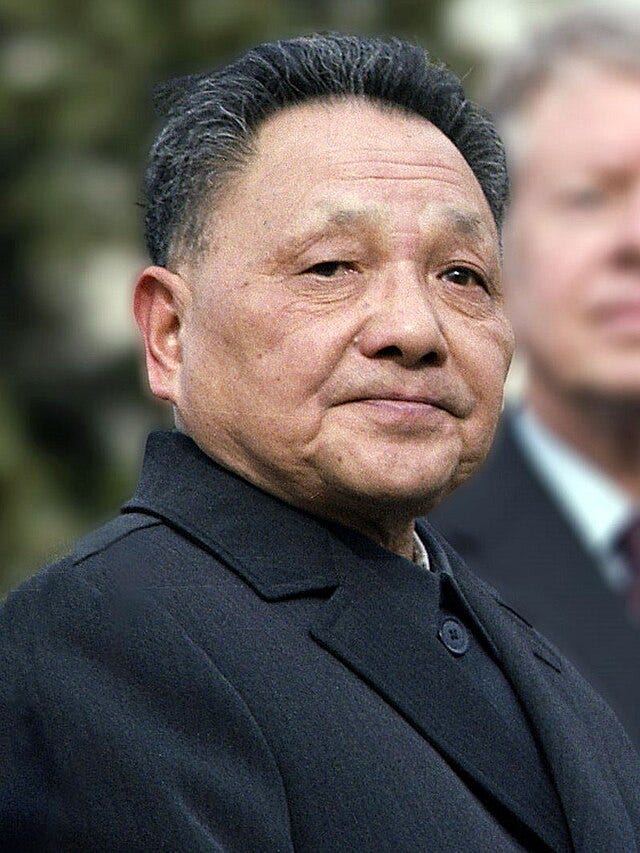
Continuing, China’s integration–rather than ideological repudiation–of the international system was decisive in enhancing its own military and economic power. This is evidenced by China’s improvement of its national credit and financial systems underpinning its lending profile today; bilateral trade agreements with the United States, which expanded its domestic productive capacity; and the facilitation of a more competitive domestic economy, which has increased the performance of its enterprises. All of this — impossible without its shift to “opening up”-has increased China’s national wealth, technology, and productive forces, enabling the elevation of its military into a first-rate superpower.
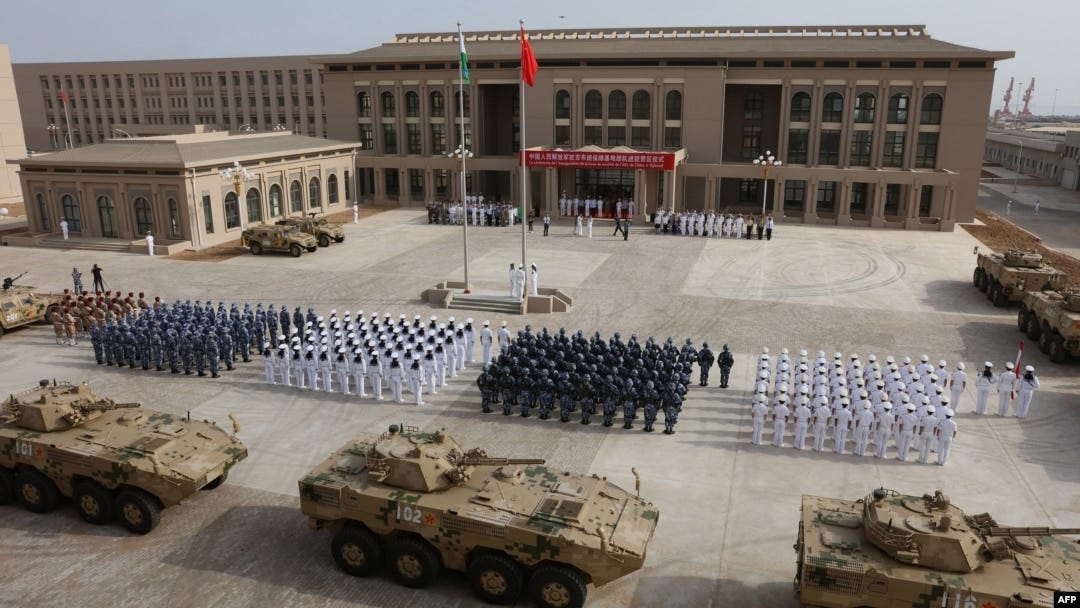
China’s military has also departed from an old policy, that of not sending troops abroad. This policy was in place under Mao Zedong and was frequently cited as a reason why China would not intervene in the Vietnam War by analysts. Today, China has established its first overseas military bases, and the host of this unprecedented action is none other than Djibouti, an African nation. China’s economic relationship with Djibouti is a case study in how China leverages loans and economic aid for geopolitical influence and the strategic expansion of its military presence. Like much of sub-Saharan Africa, the PRC is Djibouti’s largest creditor, holding about $1.4 billion in Djibouti’s debt 7 according to the International Monetary Fund. This large amount of debt owed by Djibouti to China is equal to 45% of Djibouti’s GDP. The maintenance of the Djibouti-China economic cooperation, which is in Djibouti’s interest to pursue as a way of jumpstarting its economy, would require Djibouti to remain consistent on paying its large debt, which may be untenable for its weak economy. This places it in a weaker negotiating position and grants China a considerable amount of leverage, which may have helped China to bring about an agreement regarding China’s base in Djibouti. Indeed, the Center for Naval Analyses found that China is notably stringent when it comes to debt owed to it8, and such a hardball approach may incentivize its debtors to accept Chinese offers for rescheduling or forgiveness on the basis of raw resource payment, infrastructure access, and as may very well be in the case of Djibouti, military presence. This is a significant detail in evaluating China’s African investment strategy. The Center for Naval Analyses noted that “PRC lenders favor extending repayment periods or holding infrastructure as collateral on loans.”9 This reinforces the idea that China leverages investment to obtain resources, infrastructure access (which often has a dual civilian-military usage 10), and military presence. Reinforcing this line of reasoning, a publication by the Congressional Research Service11 stated that “some U.S. officials have expressed concern that Djibouti’s large debt to China could give the latter undue leverage.”
China’s dubious description of its Djibouti military base suggests there is indeed a principal motive aside from goodwill and simply benign aid. China has described the base as a “logistics” or “support facility” intended for anti-piracy operations, peacekeeping, and humanitarian operations12. However, the base is supplied with capabilities that far exceed what is necessary for anti-piracy operations. China’s Djibouti base stations Type 052D guided-missile destroyers13, contains cyberwarfare capabilities14, and deep-water piers capable of hosting aircraft carriers15. It is highly plausible that the rhetoric of Chinese policymakers downplays the offensive capabilities of their infrastructure and port enterprises in Djibouti, supporting the idea that Chinese commercial ventures in Africa are linked to military objectives, the Djibouti facility being a successful example.
While Djibouti represents the most prominent and most advanced form of instrumentalization of economic involvement for political and military influence, there are numerous other cases. In Equatorial Guinea, China helped construct Bata Port, a deepwater facility on the Atlantic coast. This followed Chinese loans and construction aid as well as opaque debt deals–Equatorial Guinea’s debt to China amounts to around 49% of its GDP. U.S Intelligence speculates China will use its influence over Bata Port to establish a PLA Naval facility. Chinese enterprises have also helped construct and have bought shares in ports in Kenya, Tanzania, and Djibouti (aside from its already established naval facility). These are countries which largely struggle to repay loans and have not yet reached a level of economic self-sufficiency. China is unlikely to invest in them expecting direct monetary reward. Instead, China is playing a geostrategic long game, a culmination of the policy of “Hide Your Strength and Bide Your Time”–a policy where China is to moderate its ideological rigidity, embrace the rest of the world and the west, and use global economic institutions and cooperation with America to achieve parity and eventually exceed it. The volume of economic interactions between China and sub-Saharan African countries which gives China access to infrastructure with military potential, the operational capability of the Djibouti base, and which cause these nations to be dependent on China–in addition to the stark departure from its previous military policy–suggest that China is utilizing investment in Africa as bargaining power for military and political objectives.
AMERICAN POLICY IMPLICATIONS
China’s expansion of its operations in Africa presents a credible geopolitical threat to the United States of America, especially as the power projections of the two nations are increasingly perpendicular; America is a liberal-democratic nation whose foreign policy tradition encompasses one based on rule of law, self-determination, and adjudication of disputes. On the other hand, China is fundamentally motivated by the ideological precepts of Communism, even if the rigidity of its doctrine is adjusted for a goal which is nonetheless predicated in Chinese Communism. Indeed, Chinese policymakers characterize their opening-up reforms as being Marxist-oriented in nature, exemplified by President Xi Jinping’s remarks16: “…No matter how the reform is carried out, the fundamental things such as adhering to the overall leadership of the Party, adhering to Marxism, adhering to the path of socialism with Chinese characteristics, and adhering to the people’s democratic dictatorship must not be shaken.” If America and China are two superpower peer-competitors operating by historically contrasting ideological frameworks, it must then follow that each shall seek to wield its power and utilize the international system toward its ends and prescriptions for international relations. Therefore, this zero-sum game environment necessitates America’s formulation of policy in response to Chinese endeavors in Africa. This article will now seek to outline measures and guidelines for American policy to counteract Chinese influence in Africa without overextending itself as it sustains operations throughout the world.
Linkage
Increase Chinese strategic costs for military expansion in Africa, and China’s endeavors in Africa will be contained.
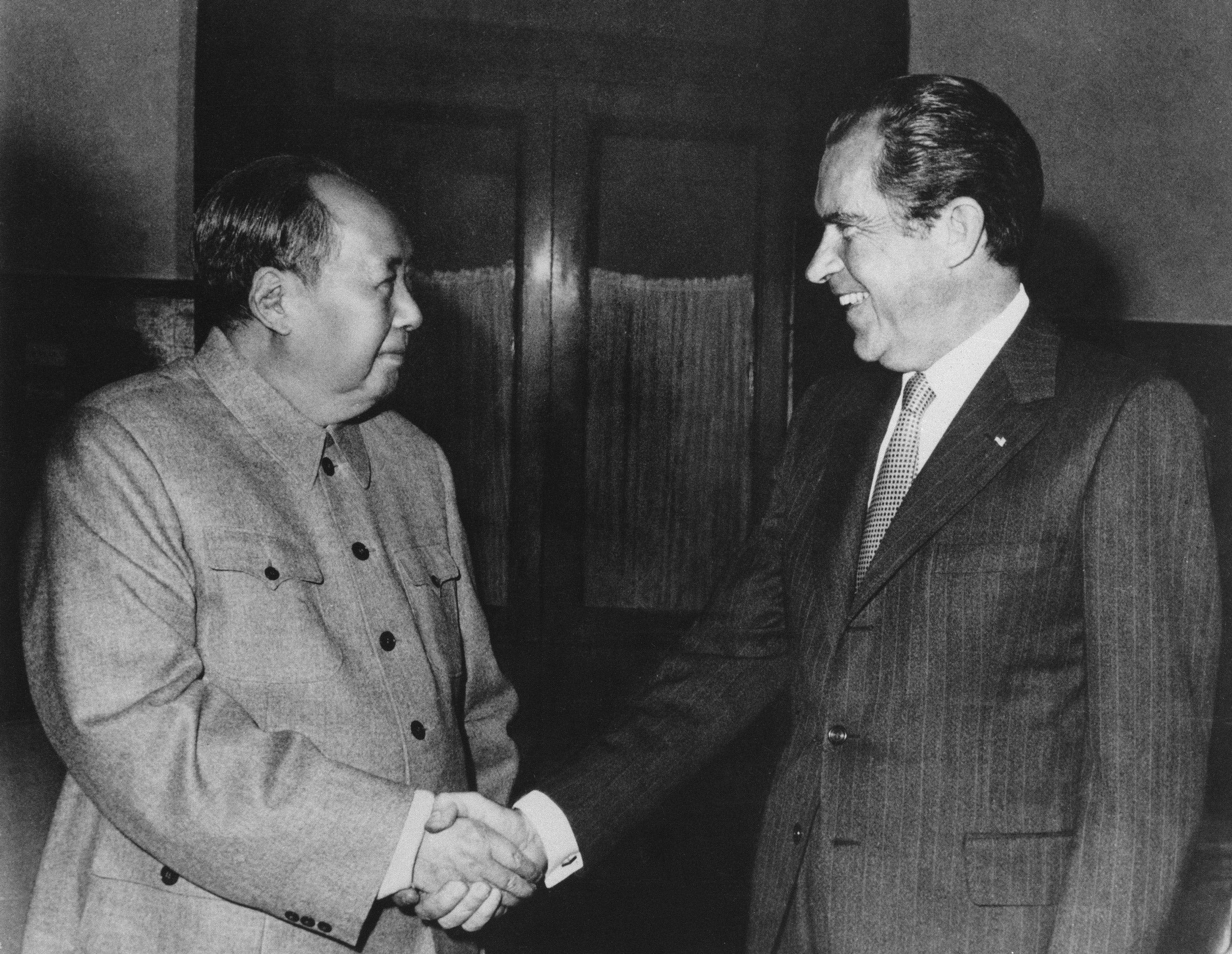
The United States of America already has well-established relations with the People’s Republic of China. Naturally, there are areas where American and Chinese interests converge, and where they diverge. For instance, the United States of America and the People’s Republic of China both have an interest in maintaining strong economic ties and robust trade–U.S. total goods trade with China were an estimated $582.4 billion in 202417–, whereas American and Chinese interests diverge over Asian security matters (China is becoming increasingly perceived as adversarial among American allies). The policy of linkage18 was first explicitly employed by President Richard Milhous Nixon, who aimed to navigate relations with the Soviet Union by connecting progress on one issue to that of a different issue. If the USSR sought progress on issue A, it would need to make progress on issue B. This allowed the United States to incentivize Soviet behaviors that aligned with American policies, and it succeeded in procuring strategic arms limitation treaties (SALT) and favorable peace conditions in Vietnam. Additionally, improved relations and diplomatic momentum obtained by the agreements obtained by linkage has a spill-over effect, whereby negotiations and consensus building on other issues become more viable as opposed to a more tense and confrontational disposition. What American policymakers should be asking is: How can we create incentives for China to conduct a policy increasingly aligned with American interests, and how can pressure be placed on them in areas where America has leverage to do so, in hopes of extracting concessions and agreements in other areas?
To operationalize linkage, the United States could apply pressure in areas where China is vulnerable to extract agreements that limit and temper its military and economic expansion in Africa. The United States may leverage strategic tariffs which may only be alleviated through a reduced Chinese presence in Africa, or agreements that China shall not seek to increase its military presence in Africa. If an issue ever arises in another area of policy, such as Taiwan and other East Asian matters, the United States should certainly seek to link progress there with understandings and Chinese concessions in Africa. Another realm of possibility is the prospect of increasing our economic and military cooperation with Taiwan and East Asian states in proportion to Chinese military expansion in Africa. This creates a new variable in the strategic calculus of Chinese policymakers, who will now have to account for increased American interference over Taiwan, which may be seen as too great a cost for acquiring military bases in Africa. This historically successful policy of linkage has the potential to provide a foundation for plausible Chinese acquiescence to American requests and demands in regards to Africa, and anywhere else Chinese and American policies diverge. However, it is crucial that the foreign policy and national security apparatus institutionalize this policy as a more permanent strategic doctrine, lest Beijing feel that they can wait out American pressures which may fluctuate with election cycles. The perception of permanence influences foreign decision-making and instigates their recognition of the totality of consequences.
Strategic Cooperation with Clients; Client Self-Reliance
America must enter strategic military cooperation with African nations; by being a source of security, it will incentivize American alignment
To prevent American overextension as it seeks to increase its strategic presence in Africa, strategically viable nations that American policymakers decide to cooperate with should be primarily responsible for their defense, with America providing military advisors and expertise, not directly enhancing the conventional military capabilities of its colleagues. Integrating American strategic command and doctrine with that of the client African nations whose own armed forces are the primary subject of these will have a two-dimensional effect: it will lead select African nations to view America as essential to its national security capabilities and military professionalization, while American resources and efforts will not be strained by yet another theater. Additionally, the United States can leverage its cooperation and military instruction to draw these African nations nearer to its own sphere and away from China. Increased alignment with America must provide benefits; increased alignment with China must be costly. The fundamental strategic reality at present is the inverse of this formula, which is why African nations welcome China while a distant America has nothing to offer. Finally, American policymakers should also look into the formation of regional defense blocs entailing military cooperation among African nations, which would multiply their self-reliant defense capability more than one African nation could, enhancing the benefits of this “Africanization” policy.
Entry Into African Markets
America cannot allow China to usurp its position as the benefactor of underprivileged nations by neglecting Africa’s potent emerging market.

One of the principal causes for African interest in Chinese patronage is the fact that China is the only nation of considerable power and wealth that has approached African nations and their emerging markets, whereas most other nations, including the United States, pay little attention to the emerging African economies. Indeed, media perception of Africa in the United States still renders Africa as in a socioeconomic stasis, making only negligible progress. However, the increased inter-African economic cooperation and integration through the African Union and the African Free Trade Zone has the potential to create a robust consumer market and economy with many resources at its disposal. The United States should reevaluate its approach to African economies, identify areas for potential investment that contribute to America’s national interest, and begin treating African nations and their economies as valid stakeholders in the world economy. China is embracing this “small-nations diplomacy,” bestowing the first major acknowledgment of these peripheral nations, whereas America often does little in the same vein. This disparity causes the policymakers of African nations to associate China with recognition, diplomatic engagement, and economic growth, with no other nation treating Africa according to its true potential and emerging role in the world. The United States must engage African nations diplomatically and evaluate how an American entry into the consolidating African market may be orchestrated, lest America arrive too late, with China exercising disproportionate leverage, positioning Africa as a bargaining chip to be used against the United States.
Holding China Accountable
America must leverage its international political leadership to contain Chinese expansion.
The final pillar of what this article seeks to establish as veritable guidelines and tactics that warrant investigation by American policymakers is the instrumentalization of America’s unmatched international preeminence and even political leadership of much of the world community to pressure China and restrict its military expansion within Africa. China made a bold and unprecedented move in establishing a military base in Djibouti. China’s quiet and subtle expansions of its power and influence often lack the noise required to precipitate American investigations. Indeed, when China scatters fighters over Taiwan in military exercises, the media reports with intensity. Yet in comparison to that temporary show of force, a permanent military base being erected is concerningly unknown and is not prompting serious policy formulation within our government. China thus sustains what can be called a “creeping expansion,” and this is seen in the case of China’s base in Djibouti. As mentioned earlier, China describes this facility as a “support facility” for “anti-piracy operations.” However, American policymakers should not be so quick to defer questioning of China’s stated motives, which might be guises. The Djibouti facility contains munitions that far exceed what is necessary for anti-piracy operations and is mere miles away from the American Djibouti base. The United States of America should make issue out of these discrepancies, courting international public opinion to instigate Chinese action. Should China obfuscate, its credibility diminishes, and America gains diplomatic leverage. The United States may use its leading role in organizations like the United Nations to question Chinese military expansion in these regions, especially when their stated reason does not explain their true capacity, using this to acquire international support and credibility in seeking to contain Chinese expansion. By making its case before the world and letting its respected voice be heard, America can shed light on China’s hitherto ignored gambits, making the Chinese strategic situation more complicated and granting leeway to our strategists in preserving American security and influence.
CONCLUSION
Within the last couple of decades, China has embarked on investment and cooperation with Africa to an unprecedented degree. Their status as the first major nation to do so leads to the African perception of China as their best hope to actualize their potential in the international system, obtain diplomatic recognition, and ameliorate their economic deficiencies. The detachment and disinterest of American policymakers in regards to Africa and the negligence of China’s expanding influence, which is not only political and economic but also a military influence, allows China to undermine America’s strategic position in the emerging competition between the two predominant economic and military powers with deeply contrasting ideologies. Either America shall make moves to incorporate Africa into its diplomatic calculus, maintain American status as the hope of impoverished nations, and counteract China’s “creeping expansion,” or it shall concede Africa’s resources, the potency of its emerging consumer market, and political alignment to Chinese dominance. China has recognized that the future of the world will be either American or Chinese, and China must compete and pursue a revisionist foreign policy accordingly. America has not coherently reciprocated this policy, unlike its sober-minded counterpart, and must accept the reality of contending strategic interests or face the consequences.
ENDNOTES
“Linkage (Policy).” Wikipedia, Wikimedia Foundation, https://en.wikipedia.org/wiki/Linkage_(policy).
Goodman, Matthew. The Truth About Africa’s Debt Crisis. Council on Foreign Relations, 6 July 2023, https://www.cfr.org/blog/truth-about-africas-debt-crisis-0.
International Monetary Fund. Sub-Saharan Africa Regional Economic Outlook: Chapter 6 — Debt and Development. IMF eLibrary, Apr. 2024, https://www.elibrary.imf.org/display/book/9798400239182/CH006.xml.
World Economic Forum. Why Strong Regional Value Chains Will Be Vital to the Next Chapter of China and Africa’s Economic Relationship. 28 June 2024, https://www.weforum.org/stories/2024/06/why-strong-regional-value-chains-will-be-vital-to-the-next-chapter-of-china-and-africas-economic-relationship.
FindevLab. A Study on the Effectiveness of China’s Sovereign Financing in Africa. FinDevLab, 2023, https://findevlab.org/news_and_event/a-study-on-the-effectiveness-of-chinas-sovereign-financing-in-africa.
Africa Defense Forum. Inflation, Drought Push Djibouti to Suspend Loan Payments to China. ADF Magazine, Jan. 2023, https://adf-magazine.com/2023/01/inflation-drought-push-djibouti-to-suspend-loan-payments-to-china.
Center for Naval Analyses. China’s Loans to Africa: Understanding the Risks and Implications. CNA, Mar. 2024, https://www.cna.org/our-media/indepth/2024/03/china-loans-to-africa.
“Military-Civil Fusion.” Wikipedia, Wikimedia Foundation, https://en.wikipedia.org/wiki/Military-civil_fusion.
Rennack, Dianne E. China’s Military Support Facility in Djibouti. Congressional Research Service, 2021, https://www.congress.gov/crs-product/IF11304.
China Military Online. China’s Engagement in Africa and Security Cooperation. ChinaMil, 2024, http://eng.chinamil.com.cn/CHINA_209163/Features_209191/9485815.html.
Marine Corps University. China’s Engagement in Africa: Part 2. Marine Corps University Press, 2023, https://www.usmcu.edu/Outreach/Marine-Corps-University-Press/MES-Publications/MES-Insights/Chinas-Engagement-in-Africa-Part-2.
Zhang, Chi. China’s Djibouti Naval Base: Increasing Its Power Projection Capabilities. East Asia Forum, 16 May 2020, https://eastasiaforum.org/2020/05/16/chinas-djibouti-naval-base-increasing-its-power.
Geostrategy. Understanding Xi Jinping’s “Reform and Opening Up”. Geostrategy, 2023, https://www.geostrategy.org.uk/research/understanding-xi-jinpingsreform-and-opening-up.
Office of the United States Trade Representative. People’s Republic of China. USTR, 2023, https://ustr.gov/countries-regions/china-mongolia-taiwan/peoples-republic-china.